
ZigoTrace

Tag: supply chain compliance

  • Food Safety Compliance Traceability Starts Before the Laboratory

    Food Safety Compliance Traceability Starts Before the Laboratory

    Crates of freshly harvested green beans, checked for pesticide residues before export.
    Photo by Snappr on Unsplash (source)

    Food safety compliance traceability is the ability to show, for a specific lot, not only who supplied it and who received it, but whether the records that govern its safety were true of that lot at the moment they mattered. Almost one in ten people worldwide falls ill from contaminated food each year, about 600 million illnesses and 420,000 deaths on the World Health Organization’s estimates for 2010, published in 2015, and the WHO African Region carries the highest burden per population, with more than 91 million people falling ill and 137,000 dying each year [1][2]. The burden is mostly microbial, and a residue interception is not an outbreak. The lateness is shared: by the time a laboratory can see the problem, the lot has moved, and the records that would have shown the risk were never joined. A supply chain traceability file that can name the shipper and the buyer, and still cannot say whether a spray and a harvest on the same plot were far enough apart, is complete in the sense current food law asks for and silent on the question that failed the consignment.

    Why food safety compliance traceability fails between two complete records

    A residue violation is often a relationship between two records that are each, on their own, in order. The pre-harvest interval is the minimum time between the last pesticide application and harvest, it is printed on the product label, and keeping it is a legal requirement precisely so that residues fall to or below the maximum residue limit, the concentration of that substance legally tolerated on that food [3][4]. A spray book that records the product, the dose and the date is a complete spray record. A harvest ticket that records the plot, the date and the weight is a complete harvest record. Neither document, read alone, can say whether the interval was observed, because the violation lives in the time between them. Consequently, the implications of filing those two records in different books, or in different companies, are larger than a missing signature: the exporter can produce every page an auditor asks for and still have no way to see the lot that should never have been picked.

    This is the unglamorous bit, and it is where most food-safety files quietly stop. A certificate of analysis tells you what a laboratory found in a sample after the fact. It does not tell you which other lots from the same application were not sampled, and it does not tell you that harvest fell on day three of a seven-day interval. Governed provenance has the same shape under a different rule: a record can be intact, signed and stored, and still not be true of the lot it is attached to. Food safety compliance traceability asks for that second property, the join, and most traceability systems were built to answer who held the goods, not whether the interval survived.

    What EU residue checks and Kenya’s bean exports already show

    The European picture looks calm until you look at where the failures land. In 2023 the European Food Safety Authority reported on 132,793 food samples analysed under the EU pesticide monitoring programmes. Of those, 127,816, or 96.3 percent, fell within legal limits. Maximum residue levels were exceeded in 4,977 samples, 3.7 percent, and once measurement uncertainty was taken into account 2,694 samples, 2.0 percent, were non-compliant and open to enforcement [5]. Those limits are set under Regulation (EC) No 396/2005, which is the rule a border laboratory is applying when it holds a consignment [6]. A two percent non-compliance rate is easy to describe as a system that works. Concentrated on a few origins and a few crops, it is also enough to close a market.

    Kenya’s vegetables are the worked example. CBI, drawing on the Rapid Alert System for Food and Feed, counts 28 Kenyan green-bean consignments that failed EU maximum residue levels in 2024, more than Sri Lanka, Bangladesh and India combined in the same note, and records that Regulation (EU) 2019/1793 already requires checks on 10 percent of bean imports from Kenya [7]. The Agriculture and Food Authority, reported by Business Daily, put the wider vegetable season in commercial terms: export earnings fell 53.83 percent, from Sh50.9 billion in 2023 to Sh23.5 billion in 2024, MRL interceptions rose from 25 to 57, and the authority said EU inspection of Kenyan vegetables moved from 5 percent to 15 percent, blaming notifications on French beans and snow peas [8]. Those are different series, and they should not be added. They point the same way. Several retailers in the United Kingdom, Germany, the Netherlands and Austria do not buy at the legal ceiling: CBI says they ask for 50 percent or even 33 percent of the EU limit, and some cap active substances at three [7]. A lot that passes a public laboratory can still fail the buyer paying for the freight.

    The 2024 Alert and Cooperation Network report shows the same pattern across the Union. Notifications rose 8 percent to 9,460, and Rapid Alert System notifications rose 12 percent to 5,250. About one third of those were border rejections, mainly pesticide residues in fruit and vegetables. Fruits and vegetables were the largest category in that network, 1,479 notifications, 16 percent of all Alert and Cooperation Network notices, and pesticide residues were the leading issue, with oranges, peppers, chlorpyrifos and acetamiprid recurring [9]. The laboratory is doing the job it was given. The open question is why the interval was not visible before the sample was drawn.

    Why one step back and one step forward cannot see a pre-harvest interval
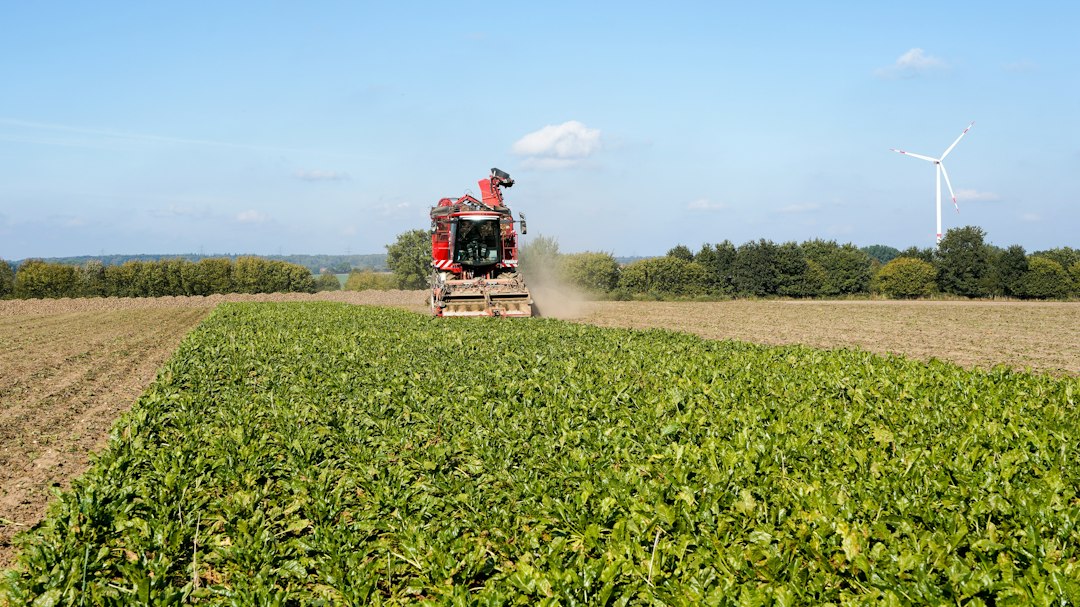
    A field worker spraying a vegetable crop, the application a pre-harvest interval is counted from.
    Photo by Wolfgang Weiser on Unsplash (source)

    European food law has required traceability since 2002, and it defined the job narrowly on purpose. Article 18 of Regulation (EC) No 178/2002 says a food business must identify who supplied it and which businesses it supplied, and must produce that information to the competent authority on demand [10]. Commission guidance calls this one step back and one step forward: supplier to product, product to customer, with no duty to name the final consumer [11]. That design is good at a recall. It is weak at a residue, because the supplier of a pooled lot may be a broker who never saw the spray, and the customer may learn the result only when a border laboratory does. Nothing in Article 18 asks whether harvest and the last application on the same plot respected the interval on the label.

    The United States is moving further along the lot, and still not as far as the interval. The Food Safety Modernization Act’s traceability rule requires a traceability lot code and key data elements at critical tracking events, including harvesting and cooling, for foods on the Food Traceability List, available to the Food and Drug Administration within 24 hours or a time the agency agrees [12]. The original compliance date was 20 January 2026. The FDA has said it will not enforce the rule before 20 July 2028, consistent with a direction from Congress [12]. A lot code that survives packing makes a recall faster, and a harvest date is useful. It still does not contain the product applied, the dose, or the interval that product required. An exporter can be ready for that rule and remain blind to the failure Kenya is already paying for.

    The EU Deforestation Regulation already asks for a relationship to a plot, not merely to the company that shipped the container. Food safety has not written the pre-harvest interval into statute in those terms. Buyers and border laboratories are enforcing it anyway, one consignment at a time.

    What has to be true before a laboratory result means anything

    A laboratory result means something about a lot only when three earlier facts are already joined: which plot the lot came from, what was applied there, and whether harvest waited out the interval on the label. ZigoTrace’s general module sits on the same provenance graph as the other compliance checks, and the pre-harvest-interval check is what that graph is for. A spray record and a harvest record, read together, can flag a residue risk that neither record flags alone. Where either record is missing, or the interval on the label is not in hand, the honest output is inconclusive, not a guessed clear. That is the same rule the product already applies when a satellite pass cannot be read: a check that cannot answer must say so. A passed certificate of analysis is a statement about a sample. It is not a substitute for the interval, and a system that prints a pass because the sample was clean is describing the sample, not the lot.

    Yet, it remains to be seen whether exporters will treat the interval as a record kept at picking, or as an argument had with a laboratory after the consignment has left. The second habit is the one the 2024 numbers describe. The first is available to any packhouse that already writes down the spray and already writes down the harvest, and simply never puts the two dates on the same line. Food safety compliance traceability, in that narrower sense, is not a new sensor and not a new certificate. It is the refusal to call a lot safe until the relationship the border is already punishing has actually been checked.

    Book a demo to see whether the spray date and the harvest date on a lot you already ship would have survived the interval.

    References

    1. World Health Organization, WHO estimates of the global burden of foodborne diseases: Foodborne Disease Burden Epidemiology Reference Group 2007-2015, 2015. https://www.who.int/publications/i/item/9789241565165
    2. World Health Organization, “WHO’s first ever global estimates of foodborne diseases find children under 5 account for almost one third of deaths,” news release, 3 December 2015. https://www.who.int/news/item/03-12-2015-who-s-first-ever-global-estimates-of-foodborne-diseases-find-children-under-5-account-for-almost-one-third-of-deaths
    3. Health Canada, “Understanding Preharvest Intervals for Pesticides.” https://www.canada.ca/en/health-canada/services/consumer-product-safety/reports-publications/pesticides-pest-management/fact-sheets-other-resources/preharvest-intervals.html
    4. Food and Agriculture Organization, “Maximum Residue Limit (MRL)” definition, JMPR appendices, after Codex Alimentarius Vol. 2A. https://www.fao.org/4/x5848e/X5848e0b.htm
    5. European Food Safety Authority, “The 2023 European Union report on pesticide residues in food,” EFSA Journal, 2025. https://efsa.onlinelibrary.wiley.com/doi/10.2903/j.efsa.2025.9398
    6. Regulation (EC) No 396/2005 of the European Parliament and of the Council on maximum residue levels of pesticides in or on food and feed of plant and animal origin. https://eur-lex.europa.eu/eli/reg/2005/396/oj
    7. CBI, “Entering the European market for fresh green beans,” updated 30 December 2025. https://www.cbi.eu/market-information/fresh-fruit-vegetables/green-beans/market-entry
    8. Linet Owoko, “Kenya vegetable exports hit by tough EU market rules,” Business Daily, 3 September 2025, reporting Agriculture and Food Authority disclosures. https://www.businessdailyafrica.com/bd/markets/commodities/kenya-vegetable-exports-hit-by-tough-eu-market-rules-5179240
    9. European Commission, Alert and Cooperation Network 2024 Annual Report, announced 2025. Commission notice: https://ec.europa.eu/newsroom/sante/newsletter-archives/63452
    10. Regulation (EC) No 178/2002, Article 18 (traceability). https://eur-lex.europa.eu/legal-content/EN/TXT/?uri=CELEX:32002R0178
    11. European Commission, Guidance on the implementation of articles 11, 12, 14, 17, 18, 19 and 20 of Regulation (EC) No 178/2002 on General Food Law, section on Article 18. https://food.ec.europa.eu/system/files/2016-10/gfl_req_guidance_rev_8_en.pdf
    12. U.S. Food and Drug Administration, “FSMA Final Rule on Requirements for Additional Traceability Records for Certain Foods.” https://www.fda.gov/food/food-safety-modernization-act-fsma/fsma-final-rule-requirements-additional-traceability-records-certain-foods

    Frequently asked questions

    What is food safety compliance traceability?

    Food safety compliance traceability is the ability to show, for a specific lot, who handled it and whether the safety-relevant records were true of that lot, including whether harvest waited out the pre-harvest interval after the last pesticide application [3][10]. Naming the supplier and the customer, which is what Article 18 of Regulation (EC) No 178/2002 requires, does not by itself answer the interval [10][11].

    What is a pre-harvest interval?

    A pre-harvest interval is the minimum time between the last application of a pesticide and harvest of the treated crop. It is stated on the product label, and keeping it is what the label relies on so that residues stay at or below the maximum residue limit [3][4].

    Does a passed residue test prove a lot was grown within the interval?

    No. A certificate of analysis reports what a laboratory found in the sample it tested. It does not show which other lots from the same application were not sampled, and it does not reconstruct the days between spray and harvest. In 2023, 2.0 percent of 132,793 EU monitoring samples were non-compliant after measurement uncertainty, which is a statement about tested samples, not about every lot that shipped [5].

    When do US food traceability records have to be ready?

    The FDA’s Food Traceability Rule requires a traceability lot code and key data elements at events including harvesting and cooling. Its original compliance date was 20 January 2026. The FDA has said it will not enforce the rule before 20 July 2028 [12].


  • Agentic AI Workflows in Compliance: Why the Best Agents Are Given Less

    Agentic AI Workflows in Compliance: Why the Best Agents Are Given Less

    An operator at a workstation reviewing monitoring screens, illustrating human oversight of agentic AI workflows in compliance.
    Photo by Miha Meglic on Unsplash (source)

    The most useful thing to know about agentic AI workflows in compliance work is that the systems now succeeding are not the ones given the most freedom, they are the ones given the least. Enterprise deployment of AI agents, meaning systems where a language model plans, calls real tools, and changes the state of a business system rather than only answering a question, has moved from pilot to production quickly enough that the telemetry is now unambiguous: multi-agent workflows on the Databricks platform grew 327 percent between June and October 2025, measured across 20,000 organisations that include 60 percent of the Fortune 500 [1]. Yet across the same period, Gartner projected that more than 40 percent of agentic AI projects would be cancelled by the end of 2027, attributing the failures to escalating cost, unclear business value, and inadequate risk controls rather than to any shortfall in the underlying models [2]. Both things are true at once, and the gap between them is not a capability gap. It is a design gap, and it is one that compliance work exposes faster than almost any other domain.

    Why agent adoption and agent cancellation are rising at the same time

    The contradiction resolves once the unit of analysis shifts from the model to the workflow around it. MIT Media Lab’s Project NANDA, drawing on 52 executive interviews, surveys of 153 leaders, and an analysis of 300 public deployments, found that roughly 95 percent of organisations were seeing no measurable profit-and-loss return on generative AI, while a small minority were extracting real value, a split the authors named the GenAI Divide [3]. What separates the two groups is rarely which model was chosen. Databricks’ own data points at the same conclusion from the other direction: supervisor architectures, in which a coordinating agent routes work to narrower specialists rather than one agent attempting everything, already account for 37 percent of enterprise deployments, and organisations operating a formal AI governance framework ship twelve times more agent projects into production than those without one [1]. Consequently, the implications of this pattern are structural rather than technological. The organisations getting returns are the ones that have decided in advance what the agent is allowed to see, what it is allowed to call, and what it must escalate, and the organisations cancelling projects are largely the ones that deployed a capable model into an undefined process and waited to see what happened.

    What actually breaks when an agent is given a whole product instead of one step

    An agent handed an entire product rather than one workflow step fails in measurable, well-documented ways, not mysterious ones. On TheAgentCompany, a Carnegie Mellon benchmark of 175 consequential, long-horizon professional tasks inside a simulated software company, the best-performing model completed 30.3 percent of tasks autonomously and scored 39.3 percent once partial credit was allowed [4], and broader reporting on real office work has put the error rate at roughly 70 percent of tasks attempted [5]. The most instructive failure mode, though, is the one that scales with ambition rather than with difficulty. As the number of tools visible to an agent grows, its ability to choose the right one degrades sharply, with one widely reported Berkeley Function Calling Leaderboard result showing accuracy falling from 43 percent to 2 percent on scheduling tasks as the visible tool count expanded from four to fifty-one [6]. The mechanism is unglamorous: probability mass spreads thin across near-duplicate tool descriptions, attention dilutes, and the model begins either inventing tool names or calling the correct tool with arguments borrowed from a different tool’s schema. Recent work has started to formalise the question of how many tools an agent should see at all, with chance-corrected methods rather than anecdote [7]. Anthropic’s own published guidance reaches the practical version of the same point, recommending the simplest pattern that passes evaluation, a fixed workflow where the path can be hardcoded, and genuine agency reserved only for problems where the number of steps cannot be predicted in advance [8]. Despite widespread optimism about general-purpose agents, the evidence increasingly suggests that narrowing is the intervention that works.

    What a scoped agentic workflow looks like inside a compliance product

    Aerial view of a coffee plantation divided into mapped plots, the plot-level geodata an EUDR due diligence statement must account for.
    Photo by Jeswin Thomas on Unsplash (source)

    A scoped agentic workflow gives the model a single step, a short tool list, and no way to answer silently. ZigoTrace’s intelligence model is built this way across five distinct layers, and the design reads as a fairly direct implementation of what the benchmark literature recommends. Chat is not scoped to the product but to exactly where the user is standing, which module (EUDR, biodiversity, or general farm operations) and which workflow step within it, such as block registry or due-diligence readiness. Before the model sees a message, the backend assembles a system message from that step’s real, current findings, pulled live from the same deterministic detector output the scoring endpoint runs, ranked by severity and capped at eight with the true remaining count stated plainly. A question about what is wrong with a given plot is therefore answered from open findings recorded against that node, not from training-data association. That distinction is not theoretical: before an identity-framing layer was added, a broad question about yield tracking pulled in generic industrial-manufacturing associations instead of the product’s own agricultural traceability domain, which is a small in-house instance of precisely the dilution effect the tool-count research describes.

    The remaining layers extend the same principle from context into action. Each module exposes one shared tool registry, used by both the chat surface’s slash commands and that module’s own tools tab, so the two can never disagree about what exists, and a command like generating a due diligence statement for a lot calls the same backend action the interface button calls rather than a parallel implementation. Structured multi-step runs live in an agent workspace where each plugin carries its own playbook, mapping plots, assessing suppliers, assembling evidence, generating the statement, with chat memory scoped per step rather than pooled across the session. The workspace discloses its own reads: a context event fires before any token is generated, stating what was actually consulted, which means the system reports one open finding rather than answering as though it had read everything. Above the raw findings sits a value-of-information ranking that decides what to fix first, feeding a review queue whose confirmations and corrections recalibrate the confidence scoring underneath. The two surfaces pointing in the opposite direction, an MCP connector letting external assistants call ZigoTrace’s own scoring and gap tools, and a terminal agent driving the same ingest commands, both keep a confirmation prompt on every command, so nothing skips a gate a human would otherwise hit. It is worth noting that MCP, the Model Context Protocol, became a vendor-neutral standard when it was donated to the Agentic AI Foundation under the Linux Foundation in December 2025 [9], which makes being callable by someone else’s agent a durable design choice rather than a bet on one vendor.

    Why two 2026 deadlines turn the agent’s own log into part of the filing

    Two regulations arriving within five months of each other are about to make the agent’s record of its own work part of the deliverable rather than an engineering nicety. The EU AI Act’s record-keeping obligation requires high-risk AI systems to technically allow automatic logging of events across the system’s lifetime, in full application from 2 August 2026, with deployers separately obliged to retain those logs for at least six months [10]. Non-compliance carries a penalty of up to 15 million euro or 3 percent of global annual turnover, whichever is higher, although the timing is not entirely settled: the Digital Omnibus agreement would defer stand-alone Annex III systems to 2 December 2027, and no finalised technical standard for Article 12 logging yet exists, with prEN 18229-1 and ISO/IEC DIS 24970 both still in draft [11]. In parallel, large operators and traders must comply with the EU Deforestation Regulation from 30 December 2026 under the revision adopted in December 2025, filing a Due Diligence Statement through the EU TRACES system before placing a covered commodity on the market [12][13]. Read together, the two deadlines describe a single requirement: an agent that participates in assembling a regulatory filing must be able to show what it read, what it called, and what it could not determine. A system that cannot produce that account is not merely under-documented, it is unusable upstream of the filing, because a fabricated pass anywhere in the chain would underwrite a false statement submitted to a regulator. This is why the constraint governing every layer described above, that a tool which cannot answer must never produce a verdict, is enforced on the non-language tools as well as on the model, and why a provider without credentials or a satellite pass obscured by cloud returns an inconclusive result rather than a guessed clear one.

    Whether scoping is a durable principle or a temporary workaround remains open

    Yet, it remains to be seen whether tight scoping is a permanent principle of agentic workflow design or an accommodation to the models currently available. The honest position is that the case for narrowing rests on benchmarks and production telemetry rather than on a settled result, and that some of what looks like architectural wisdom today may simply be compensation for context handling that improves in two model generations. ZigoTrace’s own stack reflects that uncertainty rather than papering over it: the deterministic detection layer and the confidence-fusion layer are in production, while the trained-model layer and the next-best-action ranking are built but not yet validated against customer data, having been tested only on synthetic gaps, and the automated public nature-database sources on the biodiversity side report as not connected because a licence review is outstanding. Gartner, for its part, expects roughly 15 percent of day-to-day work decisions to be made autonomously by 2028, up from effectively none in 2024, and a third of enterprise software to carry agentic capability by the same year [2]. If that holds, the organisations positioned to use it will likely be the ones that spent this period deciding what their agents are not allowed to do, since a workflow that has already defined its steps, its tools, and its escalation paths can safely be given more autonomy later, while one that never defined them has nothing to loosen.

    Book a demo to see how ZigoTrace scores what your existing records can actually prove.

    References

    1. Databricks, “State of AI Agents 2026,” January 2026.
    2. Gartner, “Gartner Predicts Over 40% of Agentic AI Projects Will Be Canceled by End of 2027,” press release, 25 June 2025.
    3. MIT Media Lab Project NANDA, “The GenAI Divide: State of AI in Business 2025.”
    4. Xu, F. et al., “TheAgentCompany: Benchmarking LLM Agents on Consequential Real World Tasks,” arXiv:2412.14161, NeurIPS 2025 Datasets and Benchmarks Track.
    5. The Register, “AI agents get office tasks wrong around 70% of the time,” 29 June 2025.
    6. Berkeley Function Calling Leaderboard tool-count result, as reported in the agent tool-selection literature, 2026.
    7. “How Many Tools Should an LLM Agent See? A Chance-Corrected Answer,” arXiv:2605.24660.
    8. Anthropic, “Building Effective Agents,” engineering guidance.
    9. Model Context Protocol, governance transfer to the Agentic AI Foundation under the Linux Foundation, December 2025.
    10. Regulation (EU) 2024/1689 (EU AI Act), Article 12 (record-keeping) and Article 26 (deployer log retention).
    11. Help Net Security, “What the EU AI Act requires for AI agent logging,” 16 April 2026.
    12. Council of the European Union, “Deforestation: Council signs off targeted revision to simplify and postpone the regulation,” December 2025.
    13. European Commission, Access2Markets, “Delay until December 2026 and other developments in the implementation of the EUDR Regulation.”

    Frequently asked questions

    What is an agentic AI workflow?

    An agentic AI workflow is a process in which a language model plans across multiple steps, calls real tools that change the state of a business system, and escalates what it cannot complete, rather than only generating text in reply to a prompt [8]. Anthropic distinguishes this from a fixed workflow, where the sequence of steps is defined in code and the model fills specific roles within it [8].

    Why do most agentic AI projects fail?

    Gartner attributes the projected cancellation of more than 40 percent of agentic AI projects by the end of 2027 to escalating costs, unclear business value, and inadequate risk controls, not to model capability [2]. Benchmark evidence supports the same reading: even leading models complete only about 30 percent of long-horizon professional tasks autonomously [4].

    Does giving an AI agent more tools make it more capable?

    No. Tool-selection accuracy degrades as the visible tool list grows, with one widely reported leaderboard result showing a fall from 43 percent to 2 percent as the tool count went from four to fifty-one [6]. Scoping an agent to a small, task-specific tool registry is currently the more reliable design [7].

    What do the 2026 regulations require of AI used in compliance work?

    The EU AI Act requires high-risk systems to support automatic event logging across their lifetime from 2 August 2026, with deployers retaining logs for at least six months [10]. Separately, EUDR large operators must file Due Diligence Statements from 30 December 2026 [12][13], which means any agent involved in assembling that filing has to be able to show what it read and what it could not determine.